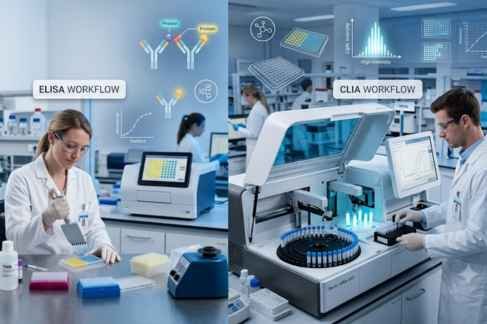
Selecting the right immunoassay is essential for obtaining accurate, reproducible, and efficient results in research and diagnostic laboratories. Two of the most widely used immunoassay techniques are enzyme-linked immunosorbent assay (ELISA) and chemiluminescent immunoassay (CLIA). While both methods rely on antigen-antibody interactions to detect target molecules, they differ in detection principles, sensitivity, workflow, and instrument requirements.
Modern chemiluminescent immunoassay (CLIA) kits have become increasingly popular because they offer enhanced sensitivity, a broad dynamic range, and compatibility with automated laboratory systems. However, ELISA remains a trusted and cost-effective method for many routine applications.
Understanding the strengths and limitations of each technique can help laboratories choose the most suitable assay for their research goals, sample throughput, and budget.
Understanding Immunoassays
Immunoassays are analytical techniques that use the highly specific binding between an antigen and an antibody to identify or quantify biological molecules.
They are commonly used to detect:
- Proteins
- Hormones
- Cytokines
- Biomarkers
- Antibodies
- Infectious disease markers
Among the many immunoassay formats available, ELISA and CLIA are two of the most commonly adopted in research laboratories worldwide.
What Is ELISA?
ELISA (Enzyme-Linked Immunosorbent Assay) is a plate-based technique that detects target analytes using an enzyme-conjugated antibody. After the enzyme reacts with a substrate, it produces a color change that can be measured using a microplate reader.
ELISA is widely used because it is:
- Well established
- Cost-effective
- Easy to perform
- Suitable for routine laboratory testing
It supports multiple assay formats, including direct, indirect, sandwich, and competitive ELISA.
What Are Chemiluminescent Immunoassay (CLIA) Kits?
Chemiluminescent immunoassay kits use antibodies labeled with chemiluminescent molecules or enzymes that generate light during a chemical reaction. Instead of measuring color intensity, specialized instruments detect the emitted light.
Because light signals can be measured with exceptional sensitivity, CLIA kits often detect lower concentrations of target analytes than traditional colorimetric assays.
Many modern laboratories choose CLIA for applications requiring high sensitivity and automated processing.
ELISA vs. CLIA: Key Differences
Detection Principle
ELISA measures a color change produced by an enzyme-substrate reaction. The intensity of the color corresponds to the concentration of the target molecule.
CLIA measures light emitted during a chemiluminescent reaction. The amount of light produced is proportional to the analyte concentration.
Sensitivity
One of the biggest differences between the two methods is analytical sensitivity.
ELISA provides reliable detection for many routine applications but may be less sensitive when target molecules are present at very low concentrations.
Chemiluminescent immunoassay kits generally offer greater analytical sensitivity, allowing researchers to detect low-abundance biomarkers that might not be measurable with conventional ELISA.
Dynamic Range
The dynamic range determines the concentration interval over which an assay can accurately measure analytes.
ELISA typically has a moderate dynamic range, making it suitable for many standard laboratory applications.
CLIA generally offers a wider dynamic range, enabling accurate measurement of both low and high analyte concentrations within the same assay.
Speed and Throughput
Many ELISA workflows involve several incubation and washing steps, making the overall assay time longer.
Many CLIA platforms support automation, reducing hands-on time and increasing sample throughput for laboratories processing large numbers of specimens.
Instrumentation Requirements
ELISA requires relatively simple laboratory equipment, including:
- Microplate reader
- Incubator
- Plate washer (optional)
- Standard pipettes
CLIA requires a chemiluminescence analyzer or compatible automated detection system capable of measuring light signals.
Although the instrumentation is more advanced, it enables higher throughput and improved reproducibility.
Comparison Table: ELISA vs. CLIA Kits
| Feature | ELISA | Chemiluminescent Immunoassay (CLIA) Kits |
| Detection method | Colorimetric | Chemiluminescent light emission |
| Sensitivity | High | Very high |
| Dynamic range | Moderate | Wide |
| Automation | Limited to moderate | Highly compatible |
| Throughput | Moderate | High |
| Equipment | Microplate reader | Chemiluminescence analyzer |
| Cost | Lower initial investment | Higher instrumentation cost |
| Best suited for | Routine research | High-sensitivity applications |
Common Applications of ELISA
ELISA remains an excellent choice for many laboratory applications.
Protein Quantification
Researchers frequently use ELISA to measure cytokines, growth factors, and other proteins.
Antibody Detection
ELISA is widely employed to evaluate antibody responses in infectious disease and vaccine research.
Biomarker Research
Numerous laboratories use ELISA to quantify disease-associated biomarkers across various research fields.
Educational Laboratories
Because of its straightforward workflow and lower equipment requirements, ELISA is commonly used in academic teaching laboratories.
Common Applications of CLIA Kits
Modern chemiluminescent immunoassay (CLIA) kits support a wide range of high-performance laboratory applications.
Infectious Disease Research
CLIA is commonly used to detect viral and bacterial biomarkers with high sensitivity.
Hormone Analysis
Researchers analyze hormones present at very low concentrations using chemiluminescent assays.
Oncology Research
CLIA enables sensitive measurement of cancer-related biomarkers, supporting oncology research and biomarker discovery.
Clinical Biomarker Studies
High analytical sensitivity makes CLIA valuable for studying proteins that occur in trace amounts.
When Should Your Laboratory Choose ELISA?
ELISA may be the preferred option when your laboratory:
- Performs routine immunoassays
- Has limited instrumentation
- Requires a cost-effective solution
- Processes moderate sample volumes
- Needs an established and widely validated method
For many research applications, ELISA continues to provide reliable and reproducible performance.
When Should Your Laboratory Choose CLIA Kits?
Chemiluminescent immunoassay (CLIA) kits are often the better choice when your laboratory requires:
- Detection of very low analyte concentrations
- High analytical sensitivity
- Broad dynamic range
- High-throughput testing
- Automated workflows
- Reduced manual handling
These advantages make CLIA particularly useful for laboratories conducting large-scale studies or advanced biomarker research.
Factors to Consider Before Selecting an Immunoassay
Choosing between ELISA and CLIA depends on several practical considerations.
Research Objectives
Determine whether your study requires routine quantification or highly sensitive detection of low-abundance targets.
Laboratory Infrastructure
Evaluate whether your laboratory has access to the instrumentation required for CLIA or whether ELISA equipment better fits your workflow.
Sample Volume
High-throughput laboratories may benefit from the automation capabilities of CLIA systems, while smaller laboratories may find ELISA sufficient.
Budget
Consider both reagent costs and the investment required for instrumentation and maintenance.
Assay Performance
Assess factors such as sensitivity, specificity, dynamic range, and reproducibility to ensure the chosen assay aligns with your experimental needs.
Conclusion
Both ELISA and chemiluminescent immunoassay (CLIA) kits are valuable tools for detecting and quantifying biological molecules. ELISA offers a reliable, cost-effective solution for routine laboratory applications, while CLIA provides superior sensitivity, broader dynamic range, and greater compatibility with automated workflows. The right choice ultimately depends on your laboratory’s research objectives, sample throughput, available instrumentation, and performance requirements.
If you want to buy ELISA and CLIA kits, you can rely on MyBioSource. They offer a comprehensive selection of high-quality ELISA and chemiluminescent immunoassay (CLIA) kits to support reliable and reproducible life science research. For more information, visit the site.