A bolted joint that passes torque inspection on installation day can still work loose within weeks under sustained vibration. Anyone who has serviced heavy equipment for long enough has seen this happen. Castellated nuts have stuck around in engineering drawings for over a century because their locking method sidesteps the wear-and-tear problem that eventually catches up with friction-based fasteners.
The Mechanics Behind the Castellated Nut
The design is straightforward. Slots machined into the top of a hexagonal nut align with a cross-drilled hole in the bolt or stud beneath it. A cotter pin or length of safety wire runs through both, physically preventing rotation. No adhesive, no thread coating, no reliance on friction between mating threads.
That last point matters more than it might seem at first. Nylon-insert lock nuts and other friction-based fasteners degrade with heat cycling and repeated installation. A castellated nut’s locking function does not weaken the same way, since the pin does the work rather than material resistance. Once seated correctly, the mechanism either holds or it does not; there is little middle ground where partial failure goes unnoticed.
Industries Where This Distinction Matters
Certain assemblies cannot risk the alternative failure mode, and specifications reflect that directly:
- Tie rods and ball joints in steering and suspension systems
- Landing gear on aircraft, both fixed-wing and rotary
- Axle nuts and wheel hubs on trucks and heavy trailers
- Shaft assemblies running under constant cyclic stress
- Crane hoists and conveyor drive systems in industrial plants
ASME B18.2.2 sets the dimensional and mechanical property requirements for hex castle nuts across North America. European suppliers tend to work from DIN 935 or DIN 937 instead, and the two standards don’t align exactly on slot geometry or bearing-surface dimensions. Torque specifications also vary by grade and thread pitch; an M12 Class 8.8 nut generally lands around 85 Nm, though that figure shifts depending on the coating and lubrication used during assembly.
Tooling Requirements Often Get Overlooked
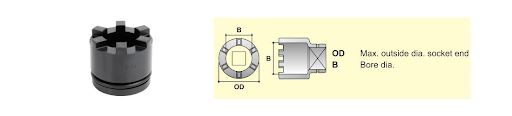
Getting the nut specification right is only step one. Removing it cleanly six months later depends almost entirely on the socket, and that is where maintenance budgets get quietly drained. A castellated nut socket has to fit the notch pattern closely and consistently. Run a standard socket on one a handful of times, and the slots start rounding off at the edges. Once that happens, lining up a new cotter pin turns into a slow, irritating job that nobody on the shop floor looks forward to.
Impact tools make the wear problem worse, not better. Shock loading from repeated impact-wrench use will chew through a poorly hardened socket faster than most maintenance teams expect. A castellated impact socket manufacturer that actually accounts for this builds wall thickness and heat treatment around impact use from the outset, rather than repurposing a hand-tool design and hoping it holds up in the field.
Conclusion
Castellated nuts still make practical sense wherever vibration is constant and a loose joint isn’t acceptable. That advantage only holds up, though, if the surrounding tooling is built for the same job. Sourcing a properly fitted castellated nut socket from a castellated impact socket manufacturer with genuinely impact-rated construction keeps the fastener’s locking function intact. It keeps routine service from turning into a repeated, avoidable headache on the floor.