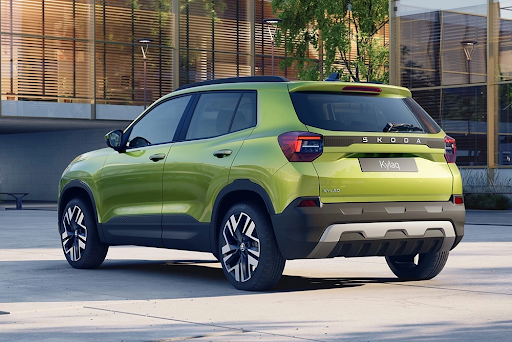
The Skoda Kylaq combines compact dimensions with an SUV-style stance aimed at everyday Indian conditions. Its ground clearance is useful for speed breakers, broken city roads and occasional rough stretches, although tyres, wheelbase and careful driving matter as much as the headline number.
Skoda Kylaq ground clearance and key dimensions
| Parameter | Figure | Why it matters |
| Ground clearance | 189 mm | Provides useful underbody clearance on uneven roads |
| Length | 3,995 mm | Keeps the SUV manageable in traffic and parking |
| Wheelbase | 2,566 mm | Supports cabin space while influencing breakover clearance |
| Wheel size | Variant-dependent | Changes tyre sidewall and impact absorption |
Skoda Kylaq officially lists 189 mm of ground clearance for the Kylaq. This is a practical figure for a sub-four-metre SUV and should handle most urban obstacles without forcing the driver to crawl over every speed breaker. The compact 3,995 mm length also helps when placing the car on narrow roads.
How the clearance works on Indian city roads
Ground clearance is most valuable when a road has tall speed humps, deep rain cuts or abrupt ramps. The Kylaq has enough clearance for typical urban use, but a fully loaded car sits lower than an unladen one. Entering steep ramps at an angle can reduce the chance of scraping the front bumper or centre section.
- Slow down before broken patches instead of braking sharply on them.
- Approach unusually tall speed breakers diagonally when traffic conditions allow.
- Maintain recommended tyre pressure, especially before a full-load journey.
- Avoid placing one side of the car in a deep rut at speed.
Is it suitable for village roads and weekend trails?
The Kylaq can deal with compacted dirt roads, gravel approaches and mildly rutted routes when driven sensibly. Its front-wheel-drive layout is designed primarily for road use rather than serious off-roading. Ground clearance does not provide the traction, low-range gearing or underbody protection associated with a dedicated 4×4.
The suspension setup and tyre profile also influence confidence. A tyre with a useful sidewall can absorb sharp edges better than a very low-profile tyre, while a well-controlled suspension prevents repeated bouncing after a large bump. Buyers should test the chosen variant because wheel and tyre specifications may differ.
Ground clearance compared with everyday requirements
| Driving situation | Likely suitability | Practical advice |
| Urban speed breakers | Good | Cross slowly when the car is fully occupied |
| Broken monsoon roads | Good with care | Avoid deep potholes that can damage tyres |
| Unpaved village routes | Reasonable | Maintain low speed and choose the smoother line |
| Rocky trails | Limited | Not intended as a dedicated off-road SUV |
| Steep basement ramps | Generally suitable | Use an angled approach where possible |
The 189 mm figure should therefore be viewed as everyday protection rather than an invitation to treat the Kylaq as an off-roader. It is enough for the conditions most compact-SUV owners actually encounter.
What else should buyers evaluate?
Ground clearance is only one part of rough-road ability. A buyer should also assess ride comfort at low speed, suspension noise over sharp edges, steering kickback, visibility, tyre replacement cost and the availability of a proper spare wheel. These factors often affect ownership more frequently than maximum clearance.
The Kylaq uses a 1.0-litre turbo-petrol engine with manual and automatic choices. Its strong mid-range can make overtaking easy, but drivers should use progressive throttle on loose surfaces because sudden torque can cause wheelspin. Hill-hold and electronic stability systems add confidence, but they cannot overcome poor grip.
- Take a test drive over the roads you use every week.
- Check the lower bumper and underbody after the test route.
- Compare ride quality with two or three direct alternatives.
- Confirm tyre size and spare-wheel provision for the selected variant.
Verdict
The Skoda Kylaq ground clearance is sufficient for most Indian city roads, highway diversions and occasional unpaved routes. Its 189 mm clearance gives it a useful margin over low obstacles, but careful driving remains essential on deep ruts and rocky surfaces. Buyers seeking genuine trail ability should consider a vehicle engineered for four-wheel-drive use, while those wanting a compact road-focused SUV should find the Kylaq suitably prepared for normal Indian conditions.
How loading and road design alter clearance
Ground-clearance measurements are normally quoted with the vehicle in a defined test condition, but daily use is less consistent. Four adults, luggage and a full fuel tank compress the suspension and reduce the available margin. A long wheelbase can also touch the crest of a sharp ramp even when the front and rear bumpers clear it. For this reason, drivers should judge the complete vehicle geometry rather than focusing on one number.
Ownership checks for rough-road users
People who regularly travel through construction zones or rural roads should inspect tyre sidewalls, wheel alignment and the lower engine area during scheduled services. Repeated high-speed pothole impacts can bend a wheel or disturb alignment without immediate warning. A simple visual check after a difficult journey can reveal a loose undertray, damaged mud flap or cut tyre before it develops into a larger problem.
One final point is the role of driver confidence. Adequate clearance should reduce anxiety, not encourage higher speed over poor surfaces. A slow, straight approach protects the tyres, suspension and passengers more effectively than relying on the SUV stance alone.