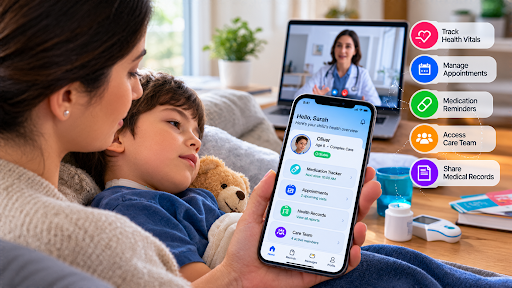
Marisol Vega keeps a three-ring binder in the back seat of her car. Inside are her son Mateo’s medication list, seizure plan, feeding schedule, equipment settings, and the phone numbers of eleven clinicians. Mateo is seven and lives with cerebral palsy, epilepsy, and a feeding tube, and for most of his life that binder was the only complete record of his care. On a rough night in the emergency room, Marisol would flip through it while a tired doctor asked questions. Last year, she began using a care coordination app that held the same information, shared it with his nurses, and put an emergency summary on her phone’s lock screen. The binder still rides in the car, but now it’s a backup, not a lifeline.
Families like hers are the reason hospitals, nonprofits, and startups reach out to a Healthcare Application Development Company with a specific goal: make daily life more manageable for parents who already do the work of a small medical team. This guide explores how digital tools are supporting families caring for medically complex children, which features matter most, where the technology still falls short, and what builders should keep in mind.
Understanding Medical Complexity
Children with medical complexity typically live with multiple chronic conditions, significant functional limitations, ongoing health needs, and often some form of technology support, such as feeding tubes, home oxygen, ventilators, or monitoring equipment. They represent a small share of children overall but need a large share of care.
Their families carry a heavy load. A parent might coordinate neurologists, gastroenterologists, pulmonologists, therapists, equipment suppliers, home nurses, school staff, and insurers, all while managing medications and watching for subtle changes in their child. Many become experts in their child’s condition out of necessity.
Hospitals known for pediatric care, such as Boston Children’s Hospital, Children’s Hospital of Philadelphia, Seattle Children’s, Nationwide Children’s, and Great Ormond Street Hospital in London, have dedicated complex care programs. Yet even the best programs can’t be present at 3 a.m. when a pump alarm goes off. That gap between clinic visits and daily reality is where apps can help.
The Coordination Problem
Ask a parent of a medically complex child what exhausts them most, and many will mention logistics before symptoms. Appointments scatter across departments, and sometimes across cities. Records live in different systems that don’t talk to each other. Each new specialist asks the same history questions. A change in one medication has to be communicated to everyone involved.
Apps address this by acting as a central hub. Families can store and share care plans, appointment schedules, test results, and contact lists. Many hospital portals, such as MyChart from Epic, give parents access to visit notes and results. In the United States, the 21st Century Cures Act pushed providers to make health information more accessible to patients and families, and in the UK, the NHS App and trust-level portals continue to expand access.
Standards like FHIR and HL7 let systems exchange data more smoothly, so a pulmonologist’s note can appear alongside a neurologist’s. Interoperability is still imperfect, but progress is real.
Emergency Information at a Glance
When a child’s condition is complicated, emergency responders and unfamiliar clinicians need key facts quickly. Diagnoses, allergies, medications, baseline vital signs, device settings, and the parent’s own guidance can change decisions in minutes.
Digital emergency summaries are becoming a lifesaving convenience. Apple Health’s Medical ID and Android’s emergency information features let people store critical details accessible from a lock screen. Dedicated apps allow families to create a clear, shareable summary, often with a QR code that can be printed on a bracelet, a bag tag, or a wheelchair.
Marisol’s summary includes Mateo’s seizure rescue plan, his baseline oxygen saturation, his feeding formula, and a short note: “He may not respond to questions the way you expect. Ask me.” That single line has changed how several triage nurses approached him.
Medication Management
Medication schedules for complex children can be dizzying. Multiple drugs, different timings, doses that change with weight, and instructions for feeding tubes leave little room for error.
Reminder apps like Medisafe and MyTherapy help families track doses and set alerts. Caregiver-focused platforms let multiple adults confirm who gave which dose, preventing accidental doubling when two people share duties. Refill reminders prevent last-minute scrambles, and photo storage helps pharmacists and clinicians verify prescriptions.
Good apps never replace clinical guidance. Families should follow their care team’s instructions and confirm any change with a pharmacist or physician before updating the app. The tool supports the plan; it doesn’t make the plan.
Tracking Symptoms, Seizures, and Vitals
Clinicians often ask, “What’s been happening since our last visit?” Parents carry that answer in memory, which is unreliable when sleep is scarce.
Symptom and event tracking apps turn memory into data. Seizure Tracker, for example, lets families log seizure type, duration, triggers, and recovery, then share reports with neurologists. Other tools capture feeding tolerance, bowel patterns, sleep, pain levels, and mood. For children with conditions like diabetes, continuous glucose monitors from Dexcom and similar devices send readings to caregiver phones, making overnight monitoring less exhausting.
Trends reveal patterns. A cluster of seizures every few weeks might correlate with illness, sleep loss, or a medication change. Visual charts help doctors see the same story the parent has been living, which can speed up adjustments to treatment.
Remote Monitoring and Telehealth
Travel itself can be an obstacle for medically complex children. Loading a child with equipment into a vehicle, arranging transport, and sitting in waiting rooms can be draining, and exposure to infections can be risky.
Telehealth reduces the burden. Video visits let specialists review progress, answer questions, and adjust plans from the family’s living room, where they can see the child’s actual environment. Pediatric centers increasingly offer virtual follow-ups, particularly for stable conditions or quick check-ins.
Remote patient monitoring adds another layer. Connected pulse oximeters, scales, blood pressure cuffs, and other devices can send data to a care team, who can respond when numbers drift. The aim is early intervention, which may prevent hospitalizations.
Telehealth doesn’t replace in-person care for everything, but it spares families unnecessary trips and keeps clinicians closer to daily life.
Coordinating the Wider Care Team
A medically complex child’s circle includes far more than doctors. Home nurses, therapists, grandparents, siblings, teachers, and respite caregivers all play roles.
Shared calendars and messaging tools help everyone stay aligned. Platforms like Lotsa Helping Hands and similar care coordination apps allow families to organize volunteers, share updates, and track tasks. A note about a rough night can reach the morning nurse before she arrives. A schedule change reaches everyone at once.
Schools benefit too. Parents can share health plans, emergency protocols, and medication instructions with school nurses and teachers through secure channels. Clear communication helps children participate in education safely.
Privacy controls matter here. Parents should decide exactly who sees what, and be able to revoke access instantly.
Peer Support and Community
Isolation is one of the least discussed burdens of complex caregiving. Friends mean well, but few understand what it’s like to manage a ventilator at midnight or fight an insurance denial for a wheelchair.
Online communities bridge that gap. Condition-specific groups, rare disease networks like NORD and Global Genes, and moderated parent forums connect families who share experiences, tips, and encouragement. Parents trade practical advice about equipment, school accommodations, and navigating hospital systems, and sometimes simply say, “I see you.”
Moderation and accuracy are crucial. Well-run communities set clear rules, discourage medical advice that contradicts clinicians, and point members toward professional help when needed.
Caring for the Caregivers
Parents of medically complex children face high rates of stress, sleep deprivation, and burnout. Apps can’t fix the structural strain, but they can offer relief.
Mental health apps provide guided breathing, short meditations, and journaling prompts that fit into fragmented time. Respite finder tools help families locate care options so they can rest. Reminder features for the caregiver’s own appointments encourage parents to look after their health, too.
The best caregiver tools respect exhaustion. They load quickly, work with one hand, offer voice input, use dark mode for nighttime, and avoid cluttered screens. When someone is running on three hours of sleep, every unnecessary tap is a cost.
Insurance, Supplies, and Paperwork
Administrative tasks swallow enormous time. Prior authorizations, denial appeals, supply orders, equipment repairs, and billing questions fill parents’ days.
Digital tools help organize this chaos. Document storage keeps letters, prescriptions, and approvals in one searchable place. Reminder systems flag renewal dates. Supply tracking apps note when formula, tubing, or dressings need reordering. Some hospital portals allow parents to request forms and referrals directly.
It’s not glamorous, but reclaiming even a few hours a week from paperwork gives families more time with their child.
Privacy, Security, and Regulation
Health data about children is deeply sensitive. Any app handling it must protect it carefully.
In the United States, HIPAA governs covered entities and their business associates, and COPPA sets rules for children’s data online. In the UK and Europe, GDPR applies, with additional protections for children’s information. The FDA regulates certain software as a medical device, particularly tools that diagnose or guide treatment, and developers should understand where their product sits on that spectrum.
Strong practices include end-to-end encryption, multi-factor authentication, role-based access, clear consent screens in plain language, secure data storage, audit logs, and the ability for families to export or delete their data. Trust is everything. A single breach can erode confidence across an entire community.
What Families Should Look For
Choosing an app can feel like one more task, so a short checklist helps.
- Does it fit your child’s needs? A seizure tracker won’t help if your main challenge is feeding schedules.
- Is it easy to use at 3 a.m.? Test it when you’re tired.
- Can your care team see it? Tools that connect with clinicians save you from repeating yourself.
- How does it handle privacy? Read the policy and check who can access data.
- Does it work offline? Hospitals and basements often have poor signal.
- Can you share selectively? You should control who sees what.
- Is it reliable? Look for regular updates and responsive support.
Always involve your child’s clinicians before relying on any app for medical decisions.
For Hospitals and Builders: Designing With Families
Teams building tools for this community should begin with listening. Parents of medically complex children are experts in their child’s care, and their insights shape better products than any assumption.
Co-design sessions with caregivers, nurses, and physicians reveal where friction really lives. Prototypes should be tested with tired people in realistic settings, not just in meeting rooms. Integration with electronic health records, using standards like FHIR, prevents duplicate data entry. Accessibility features, multiple languages, and plain language help families with diverse backgrounds.
Budget planning deserves honesty. Healthcare Application Development Cost varies with scope, compliance demands, and integrations. A focused app with care plans, reminders, and secure messaging might begin around fifty thousand dollars, while a full platform with EHR integration, remote monitoring, telehealth, and advanced security can climb well above two hundred thousand. Security audits, clinical review, and ongoing maintenance add to the total. Many organizations reduce risk by launching a narrow pilot with a small group of families, learning from it, and expanding step by step.
Challenges That Remain
Fragmented systems. Different hospitals and insurers use different platforms, so information still gets stranded.
Digital divide. Not every family has reliable internet, a modern phone, or comfort with technology. Support should include phone and in-person options.
Alert fatigue. Too many notifications can overwhelm caregivers. Smart prioritization matters.
Data overload. Tracking everything can add to the burden. Tools should surface what’s useful and let the rest rest.
Equity. Language, cost, and access gaps leave some families behind. Inclusive design and funding models help.
Sustainability. Many promising apps disappear when funding ends. Families deserve tools they can rely on.
Frequently Asked Questions
What are healthcare apps for medically complex children?
They’re digital tools that help families manage care plans, medications, symptoms, appointments, emergency information, and communication with clinicians and caregivers.
Can an app replace a child’s care team?
No. Apps support communication and organization, but diagnosis and treatment decisions belong to qualified clinicians.
Are these apps safe for sensitive health information?
Reputable apps use encryption, access controls, and privacy practices that comply with laws like HIPAA or GDPR. Always review privacy policies and choose tools recommended or supported by your care team when possible.
How can apps help with seizure or symptom tracking?
They let families log events, triggers, and recovery details, then share organized reports with specialists so treatment can be adjusted with better information.
Can telehealth work for children with complex needs?
For many follow-ups and check-ins, yes. It reduces travel and infection exposure, though some visits still require in-person assessment.
How long does it take to build a healthcare app like this?
A focused pilot can take three to six months. A comprehensive platform with integrations and compliance reviews may take a year or more.
Final Thoughts
Caring for a medically complex child is one of the most demanding jobs a person can have, and families do it with astonishing skill. Technology can’t carry the weight for them, but it can lighten the load: fewer repeated explanations, fewer lost papers, fewer nights wondering whether a message reached the right person.
Marisol still tucks the binder in the car, and she still keeps a spare phone charger in every bag. But at Mateo’s last neurology visit, the doctor scrolled through a clear timeline of seizures, medications, and sleep patterns before Marisol even sat down. “This is exactly what I needed,” she said. Marisol smiled, because for once, she didn’t have to remember everything alone.