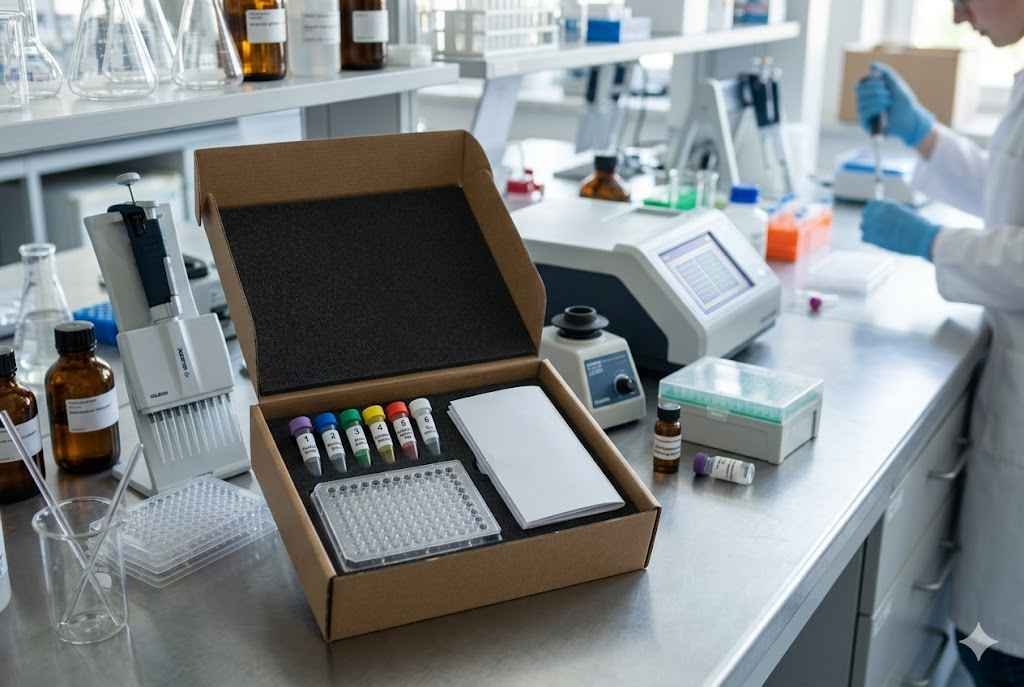
Custom-made ELISA kits address unique research needs that standard commercial assays cannot fulfill. When investigating novel biomarkers, proprietary proteins, or species-specific analytes, researchers often find catalog offerings inadequate for their experimental requirements.
Custom ELISA development enables precise assay design targeting specific analytes, optimizing performance for particular sample types, and achieving sensitivity specifications aligned with research objectives.
Understanding when custom development is worthwhile and navigating the development process to maximize return on this investment.
Situations Warranting Custom ELISA Development
Novel biomarker discovery generates targets lacking commercial assay availability. Researchers identifying proteins associated with disease progression, treatment response, or biological processes require custom immunoassays for validation studies and mechanistic investigations. Custom ELISA development enables hypothesis testing and data collection necessary for advancing findings toward publication or therapeutic development.
Species-specific requirements often necessitate custom assay development. Standard kits typically target human, mouse, or rat analytes, leaving researchers studying other model organisms or veterinary applications without suitable tools. Custom development generates assays recognizing proteins from zebrafish, Drosophila, agricultural species, or exotic disease models, expanding experimental possibilities beyond commonly available reagents.
Design Considerations and Specifications
Assay format selection balances sensitivity, specificity, and practical considerations. Sandwich ELISAs provide excellent specificity through dual epitope recognition but require two non-competing antibodies. Competitive formats suit small molecules or situations where only single antibodies are available. Indirect formats offer flexibility but may sacrifice some specificity compared to sandwich configurations.
Sensitivity requirements drive antibody selection and detection system choices. Applications demanding femtogram-level detection may require monoclonal antibody pairs with optimized binding kinetics. Less demanding applications might succeed with polyclonal antibodies offering simpler development timelines. Enhanced detection systems employing biotin-streptavidin amplification or enzymatic amplification increase sensitivity when necessary.
The Custom ELISA Development Process
Development begins with antigen preparation or provision. Recombinant proteins, synthetic peptides, or purified native proteins serve as immunogens for antibody generation. Antigen quality critically impacts resulting antibody specificity and affinity. Researchers either provide characterized antigens or collaborate with developers to generate appropriate immunogens matching project requirements.
Antibody generation follows antigen preparation, involving animal immunization, hybridoma screening for monoclonals, or serum collection for polyclonals. Screening strategies identify antibody pairs demonstrating appropriate specificity, affinity, and epitope recognition patterns. This phase typically consumes the most development time, often requiring three to six months depending on immunogen immunogenicity and desired antibody characteristics.
Optimization and Validation
Assay optimization systematically evaluates variables affecting performance. Antibody concentrations, blocking conditions, incubation times, wash protocols, and detection reagent formulations undergo testing to identify optimal parameters. Checkerboard titrations comparing antibody coating concentrations against detection antibody dilutions define working conditions balancing signal and background.
Comprehensive validation establishes assay performance characteristics essential for data interpretation. Precision studies assess intra-assay and inter-assay variability, establishing reproducibility expectations. Accuracy evaluations including spike-recovery experiments and parallelism testing verify that assays accurately measure analytes in relevant sample matrices. Specificity assessments confirm minimal cross-reactivity with related proteins that might confound results.
Cost-Benefit Analysis
Custom ELISA development requires significant investment, typically ranging from thousands to tens of thousands of dollars depending on complexity. This expenditure proves worthwhile when research depends on specific analyte measurements unavailable through commercial sources. Projects requiring hundreds of assays amortize development costs across many experiments, improving economic justification.
Alternative approaches deserve consideration before committing to custom development. Adapting existing assays through cross-reactivity exploitation, developing proximity ligation assays, or employing mass spectrometry methods might address research needs more economically. Researchers should evaluate multiple analytical strategies, considering development timelines, per-sample costs, and required throughput when selecting optimal approaches.
Selecting Development Partners
Experienced custom assay developers bring expertise accelerating development while avoiding common pitfalls. Track records developing similar assays, technical capabilities for antibody generation and characterization, and quality control standards distinguish capable partners from inexperienced providers. Clear communication regarding timelines, deliverables, and intellectual property arrangements prevents misunderstandings.
Collaborative relationships prove most productive when researchers actively participate in development decisions. Providing biological context, sharing preliminary data, and offering feedback during optimization phases helps developers make informed choices aligning with research objectives. Regular communication maintains project momentum and enables rapid problem-solving when challenges arise.
Conclusion
Custom-made ELISA kits enable research impossible with standard commercial offerings, providing tailored solutions for unique analytical challenges. While development requires substantial investment in time and resources, the resulting assays deliver capabilities advancing scientific understanding and discovery. Success demands careful planning, realistic expectations regarding timelines and costs, and selection of experienced development partners. Researchers undertaking custom ELISA development gain powerful tools uniquely suited to their investigative needs, ultimately accelerating progress toward their scientific goals.